- Oct 5, 2025
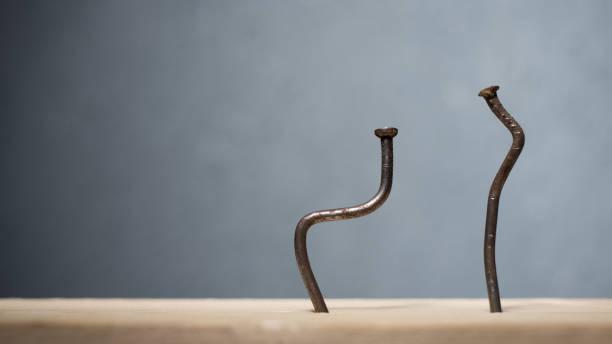
Why you don’t need to fit a mould
- Alexflowyoga
- 0 comments
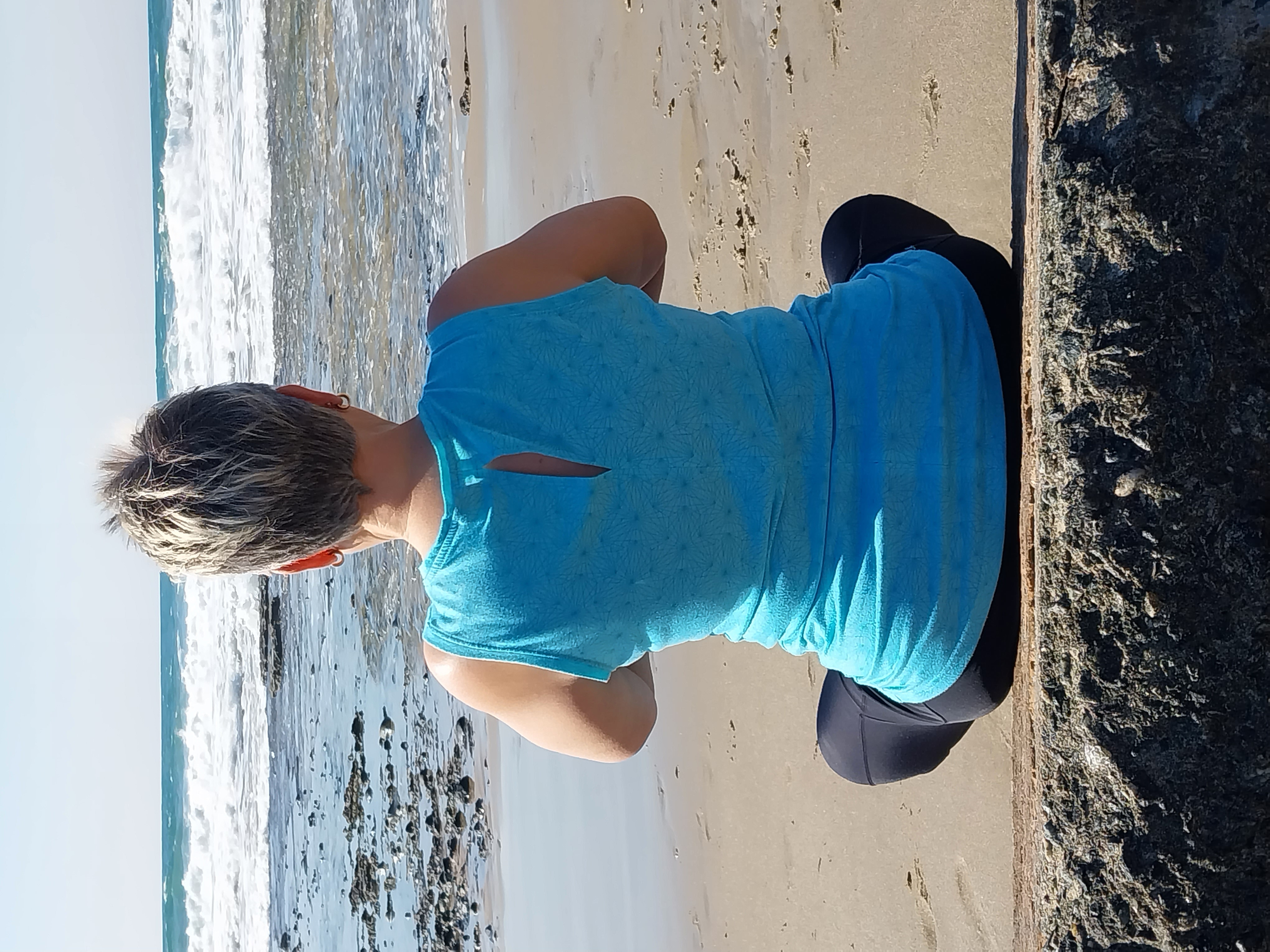
I Thought I Had to Look a Certain Way
I used to think yoga was only for the incredibly flexible – the human pretzels who could fold themselves in half without breaking a sweat. My spine has other ideas, though, because I live with scoliosis and teach yoga from a place of having a stiff inflexible body. This hasn’t limited my practice; in fact, it’s taught me the true, beautiful purpose of yoga: to find balance and strength exactly where you are. It has also taught me acceptance and to be comfortable with myself and my body.
The Leaning Tower of… Me? A Simple Scoliosis Explanation
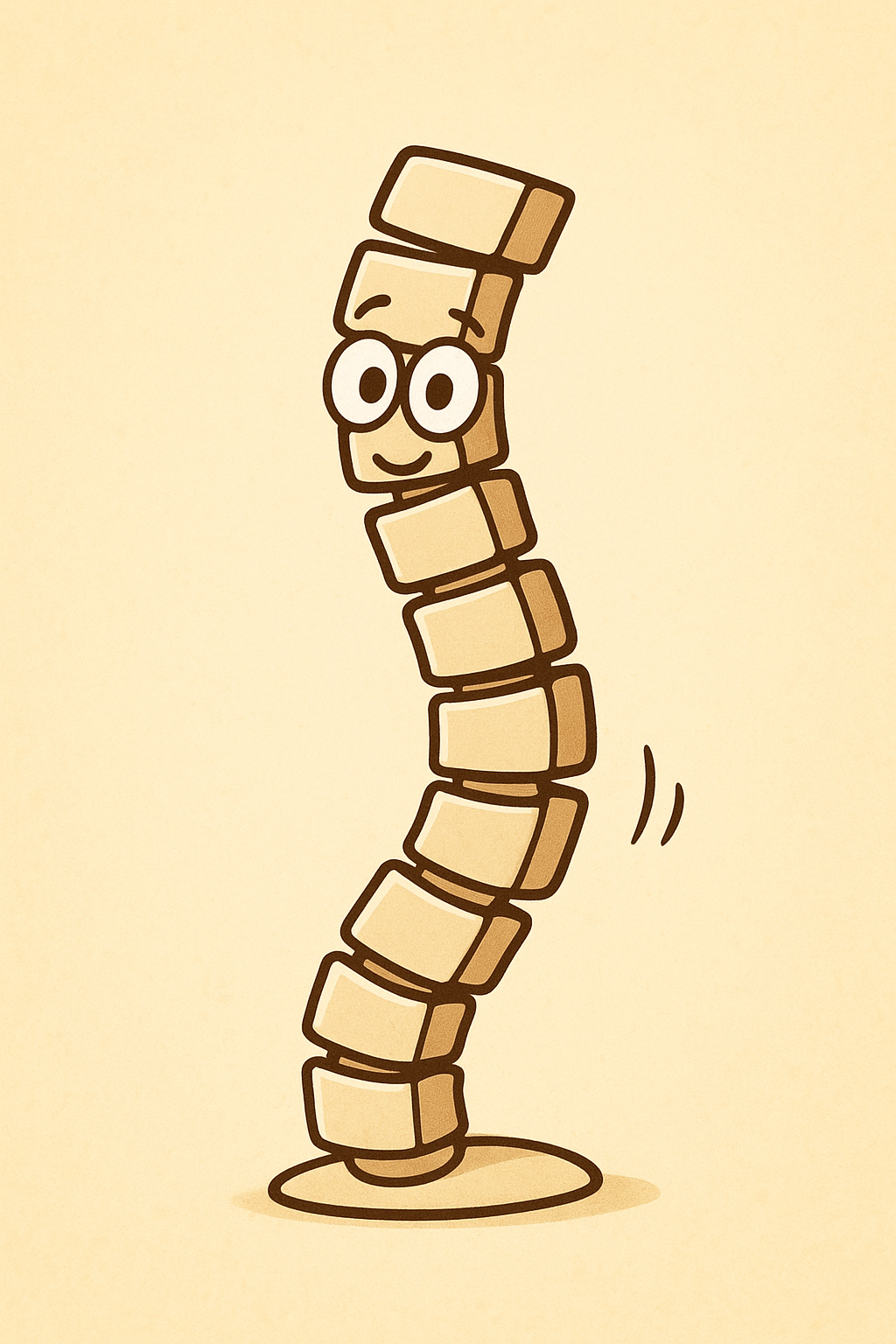
For anyone curious, here’s the simplest way I can explain what’s happening in my body and what my muscles are trying to do about it. The spine is essentially a straight, flexible stack of building blocks and my flexible stack of blocks was given a gentle, sideways nudge from the top. Scoliosis in a nutshell is a lateral curvature of the spine.
My curve happens at the top of my back, bending from my left over to my right. It’s my body’s unique architectural design, and my muscles do their best every single day to keep everything standing upright.
The Great Tug-of-War in My Back
Because my spine isn’t stacking straight up and down, the muscles on either side of it aren’t working as a balanced team. Instead, they’re engaged in a constant, unconscious tug-of-war just to keep my head over my feet and my eyes on the horizon.
On my left side: The muscles are working overtime, pulling up and tightening to counter the curve. Think of them like the ropes on a tent, pulling with all their might to keep the structure from leaning too far. This upward pull has a domino effect, hiking up my left hip and making my left leg functionally longer.
On my right side: The muscles are having a very different experience. They are pulling down, trying to anchor and stabilise the curve from the top. This constant downward pull can draw my right shoulder down and forward, which is why my right arm appears shorter.
The result isn’t a broken body; it’s a brilliantly adapted one. My muscles aren’t “wrong”; they are overcompensating to create as much stability and balance as they can from an uneven foundation.
So, What Does This Have to Do With Your Yoga Practice?
Everything. If you take only one thing from this post, let it be this: Yoga is not about touching your toes. It is not about achieving a perfect, picture-worthy pose. For me, and for everyone, yoga is about listening to your body. It’s about noticing what is happening within your body and learning to breathe into it. It’s about finding a moment of stillness and strength, curiosity and gratitude for the incredible machine your body is.
My practice looks different. Some twists are easier on one side than the other. Some stretches feel more intense. And that’s perfectly okay. My yoga mat is the one place where I can honour my body’s unique structure without judgement. I work with my curve, not against it. I strengthen the muscles that are weak and gently stretch the ones that are tight, not to “fix” myself, but to find a more comfortable and empowered balance. I mobilise my joints, to ensure they work smoothly and to reduce the risk of injury as I age, amongst other benefits.
Flexibility is not a prerequisite for yoga; it is a potential byproduct.
The true goal is awareness, breath, and showing up for yourself exactly as you are.
So, if you’ve ever thought, “I can’t do yoga, I’m not flexible enough,” I’m here to tell you that you are exactly flexible enough to start. Your body, whether it’s “textbook straight” or uniquely curved like mine, is ready and waiting to learn its own beautiful, balanced practice.
You don’t need to be flexible. You just need to be willing to try.